Disc Bearing
Disc bearings manufactured by Vinh Hung Investment and Production Co., Ltd. (Vinh Hung IP) comply with AASHTO LRFD; TCVN 11823:2017.
The disc bearings meet the requirements for high load capacity, displacement, and large rotational angles. They provide an optimal solution for medium- to long-span bridge structures where large rotational capacity is required.
Product Features
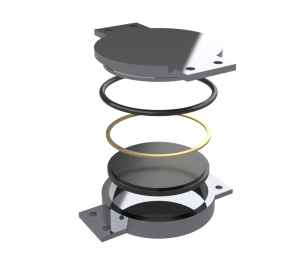
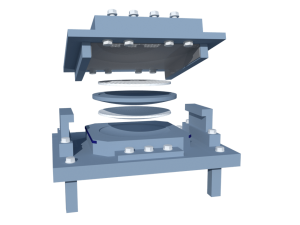
The disc bearing consists of the following main components: an elastomeric disc, an upper steel plate, a lower steel plate, a shear pin.
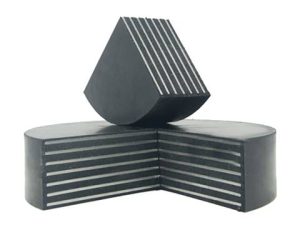
- Elastomeric Disc: The disc is manufactured from high-performance polyurethane material with excellent compressive strength. Owing to the elastic properties of the disc, the upper steel plate is able to rotate about any horizontal axis. This rotational capability is further enhanced by the V-shaped groove formed around the outer edge of the disc.
- Upper and Lower Steel Plates:
- Distribute and transfer loads uniformly from the superstructure to the substructure.
- Provide positioning and support for the shear pin.
- For guided bearings, the upper steel plate is equipped with guide bars to restrict or permit movement in the required direction generated by the structure.
- Shear Pin: Located at the center of the polyurethane disc, the shear pin stabilizes the disc, resists horizontal forces, and maintains the correct alignment of the upper and lower steel plates.
- Sliding Surface (where applicable): The sliding assembly consists of a low-friction PTFE/UHMWPE sliding element in contact with a stainless steel sliding surface.
Disc bearings are categorized into two main types:
- Fixed Bearing: A fixed disc bearing allows rotational movement of the bridge superstructure while transferring loads through a fixed point without permitting translational movement.
- Sliding disc bearing: This type of bearing, including guided sliding disc bearing and free sliding disc bearing
To ensure the long-life durability, Disc Bearing is protected against corrosion by the following methods: two-component epoxy coat, PU-based painting (Polyurethane) in accordance with the corrosion categories specified in ISO 12944 (TCVN 12705). In particular, the Al–Mg thermal spraying method (at the ratio of 95% Al and 5% Mg) ensures the anti-corrosion durability of up to 100 years, proven by salt-spraying test in 12.000 hours (8-hour dry-wet cycle repetition) under ASTM B117 standards.