

QMV Anchorage Systems
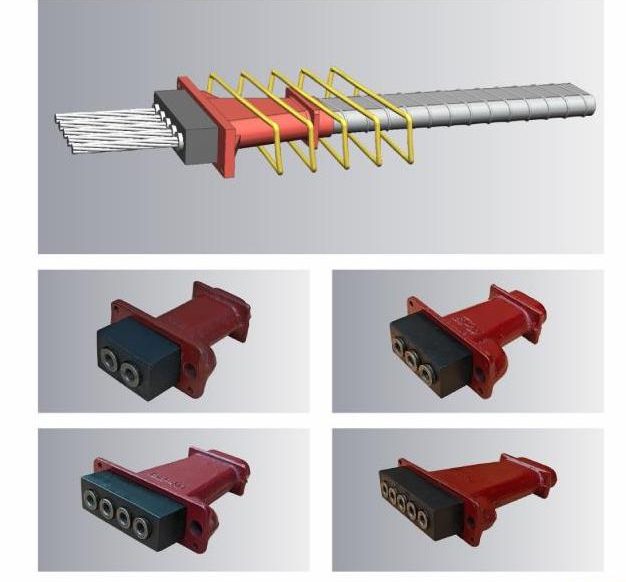
High-strength prestressing anchorage systems are specialized mechanical assemblies used in prestressed concrete structures to anchor and transfer the tension force from the PC cables into the concrete structure. The product portfolio comprises a wide range of types, satisfying design and construction requirements from standard projects to highly complex structures. Common product categories include: active anchorages (including two main configurations: round and flat anchorage assemblies), passive anchorages, and couplers. All categories are classified and fully compatible with cable diameters of 12.7 mm and 15.2 mm. The anchorage systems are available in diverse product codes, accommodating anywhere from 1 to 31 cables per anchorage head.
Product Features
In terms of basic configuration, the anchorage system consists of four main components: the anchorage head, which receives and distributes the prestressing force; the wedges, which are conical alloy steel elements with serrated teeth gripping the surface of the prestressing cables to lock and retain the cables within the tapered holes of the anchorage head; the bearing plate, which bears against the concrete and is responsible for transferring the entire anchorage force into the structure; and the spiral reinforcement, which is spring-shaped spiral steel reinforcement placed beneath the bearing plate to enhance the concrete’s resistance to localized stresses in the anchorage zone.
Regarding material requirements, the anchorage head is manufactured from C45 steel with a surface hardness of (28 ± 4) HRC or higher strength steel; the wedges are made of heat-treated alloy steel with a surface hardness of (59 ± 3) HRC; the bearing plate is cast from GX15-32 gray cast iron with flake graphite or higher strength steel; and the spiral reinforcement is fabricated from CT38 steel or a higher strength plain round bar.
All component parts shall be protected by paint coating or zinc galvanization with a coating thickness ranging from 8 to 12 µm to ensure corrosion resistance throughout the service life.